










Copyright © 2026 ROTER Fresh Air Technology Wuxi Co., Ltd. All Rights Reserved. Website Design by Wangke
Sizing a heat recovery ventilator comes down to four numbers: fresh airflow in m³/h, external static pressure in Pa, the heat recovery type (sensible or total), and the outdoor design conditions — the airflow comes from the larger of the per-person minimum and the air-change rate, the static pressure comes from the duct resistance, and the recovery type follows from whether latent load matters in your climate. ROTER's published range runs from 200 m³/h single-flow units to 15,000 m³/h ceiling-mounted total heat recovery units, with 68–76% temperature recovery efficiency measured at GB/T 21087 conditions.
Fresh air volume is the first number and everything else follows from it. The rule is simple: use the larger of the minimum per-person rate and the air-change requirement. Taking the smaller of the two will produce an ERV that cannot ventilate the space properly.
Fresh air volume reference — from the ROTER product manual
| Occupancy type | Minimum fresh air per person | Source |
|---|---|---|
| General office | 30 m³/h per person | ROTER product manual |
| High-grade office | 30–50 m³/h per person | ROTER product manual |
| Residence or villa | 30–50 m³/h per person | ROTER product manual |
| Shopping mall | 15–25 m³/h per person | ROTER product manual |
| Large shopping mall (alternative basis) | 30% of the central air conditioning total supply air volume | ROTER product manual |
Air-change rate (ACH) reference
| Room type | Air-change rate | Source |
|---|---|---|
| General rooms | 1–2 ACH | ROTER product manual |
| Computer rooms | 2–4 ACH | ROTER product manual |
| Smoking-intensive meeting rooms | 3–8 ACH | ROTER product manual |
A worked example makes the arithmetic clear. A general office of 120 m² with 10 occupants at 30 m³/h per person needs 300 m³/h on the occupancy basis. If the room volume gives 2 ACH on a 3 m ceiling — 720 m³ of room volume — that is also 360 m³/h. The larger figure, 360 m³/h, governs. For industrial workshops where harmful substances are released, size the airflow to dilute the pollutants to safe concentrations instead.
The external static pressure is not a free choice — it is what the duct system needs to overcome. Getting it wrong in either direction is expensive: too high and the fan burns more power than necessary, too low and the unit will not deliver its rated airflow.
Published static pressure by range — ROTER measured data
| Product range | Airflow (m³/h) | External static pressure (Pa) | Source |
|---|---|---|---|
| Single-flow fresh air ventilator (RS series) | 200–1,000 | 120–140 | ROTER published performance table |
| Standard haze / DC inverter fresh air ventilator | 200–1,000 | 100–120 | ROTER published performance table |
| Medium ceiling-mounted total heat recovery (CXH) | 1,000–15,000 | 120–400 | ROTER published performance table |
| Vertical total heat recovery (CHX-L) | 1,500–15,000 | 158–460 | ROTER published performance table |
| Long-range jet air handling unit | 1,200–12,000 | 0 | ROTER published data |
| Modular building-block AHU | 2,000–80,000 | See model selection | ROTER product announcement |
This is the decision that most affects both capital cost and running cost, and it is a climate question rather than a technical one. A sensible heat exchanger moves temperature only. A total heat exchanger moves temperature and moisture, which costs more per square metre but removes latent load from the cooling plant.
Recovery type comparison
| Criterion | Sensible only | Total heat |
|---|---|---|
| Heat transferred | Temperature | Temperature + moisture |
| Published ROTER efficiency | 73–76% sensible (CHX-L) | 68–76% total (CXH / CHX-L) |
| Removes latent load | No | Yes |
| Cross-contamination | None — streams separated | None — only water vapour molecules pass the core |
| Best suited to | Dry climate, heating-dominated load | Any climate with a meaningful cooling load |
The practical test is whether the building has a cooling load that matters. Where it does, total heat recovery is almost always the right answer, because in most commercial climates the moisture in the outdoor air is at least as expensive to remove as its temperature. The ERV vs HRV comparison sets out the full decision path.
Core type selection
| Duty | Recommended core | Key constraint |
|---|---|---|
| Clean exhaust, maximum stream separation required | Plate heat exchanger | No moving parts; zero cross-contamination |
| Large airflow, high duct static pressure | Rotary heat exchanger | Motor and drive to maintain; φ500–φ5000 mm available |
| Exhaust above 120°C | ECW high-temperature rotary rotor | Rated to 300°C |
| Dusty or corrosive exhaust | Heat pipe heat exchanger | Consumes no power; effective condensate drainage |
| Very large project, staged delivery | Modular building-block AHU | 2,000–80,000 m³/h |
The last and most commonly missed step is that catalogue efficiency is measured at a fixed condition, not yours. ROTER's figures are stated at GB/T 21087 operating conditions, and those are worth knowing precisely because they are the baseline you will be quoted against.
GB/T 21087 test conditions and measured results — ROTER
| Parameter | Value | Source |
|---|---|---|
| Summer — outdoor dry-bulb | 33°C | ROTER CXH performance table, note 2 |
| Summer — outdoor relative humidity | 80% | ROTER CXH performance table, note 2 |
| Summer — indoor dry-bulb | 26°C | ROTER CXH performance table, note 2 |
| Summer — indoor relative humidity | 50% | ROTER CXH performance table, note 2 |
| Winter — outdoor dry-bulb | 0°C | ROTER CXH performance table, note 2 |
| Winter — outdoor relative humidity | 30% | ROTER CXH performance table, note 2 |
| Winter — indoor dry-bulb | 20°C | ROTER CXH performance table, note 2 |
| Winter — indoor relative humidity | 60% | ROTER CXH performance table, note 2 |
| Measured total heat recovery efficiency | 68–76% across the CXH range | ROTER CXH performance table |
| Measured sensible heat efficiency | 73–76% (CHX-L series) | ROTER CHX-L performance table |
ROTER's own note on the published table states: "If the operating conditions change, the actual efficiency may fall outside the stated enthalpy recovery efficiency range." Ask for the efficiency at your design conditions — that is a different number, and it is the one that decides your running cost.
The reason heat recovery is specified at all is the effect on the energy bill, and that effect can be quantified. ROTER's documented measurement on a 200 m² room in Beijing is the clearest available example.
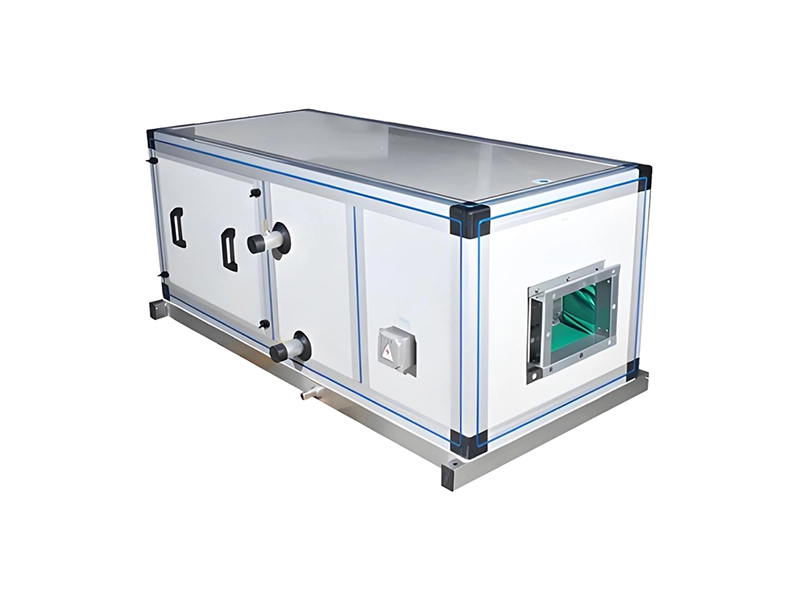
Measured energy saving — total heat recovery, 200 m² room, Beijing
| Parameter | Value | Source |
|---|---|---|
| Outdoor temperature, summer | 33°C | ROTER published case study |
| Supply air temperature with heat recovery | about 28°C | ROTER published case study |
| Supply air temperature with plain ventilation | about 7°C | ROTER published case study |
| Energy saved, winter | approximately 1,112 kWh | ROTER published case study |
| Energy saved, summer | approximately 1,427 kWh | ROTER published case study |
| Comprehensive annual saving | approximately 42.3% | ROTER published case study |
| Electricity price used | ¥0.48/kWh | ROTER published case study |
How do I calculate the fresh air volume for a room?
Take the larger of two values: the minimum fresh air volume per person and the air-change-based requirement. Reference figures from the ROTER product manual are general office 30 m³/h per person; high-grade office 30–50 m³/h per person; residence or villa 30–50 m³/h per person; shopping mall 15–25 m³/h per person. For air-change rate: general rooms 1–2 ACH; computer rooms 2–4 ACH; smoking-intensive meeting rooms 3–8 ACH. Large shopping malls can alternatively set fresh air volume at 30% of the central air conditioning total supply air volume. For industrial workshops where harmful substances are released, size the airflow to dilute the pollutants to safe concentrations.
What is the right static pressure for an ERV?
It is whatever the duct system requires — it is not a free choice. ROTER's published range runs from 100 Pa on the 200–1,000 m³/h fresh air ventilators up to 400 Pa on the larger ceiling-mounted units and 460 Pa on the vertical series. The long-range jet unit is the exception at 0 Pa, because it discharges a high-velocity jet rather than pressurised duct air.
Should I choose a sensible or total heat recovery unit?
Total heat recovery wherever the building has a meaningful cooling load. It transfers moisture as well as temperature, which removes latent load from the cooling plant — and in most commercial climates the moisture is at least as expensive to remove as the temperature. A sensible-only core is the right answer in a dry climate with a heating-dominated load.
How much does an ERV cost to run?
The running cost is dominated by the fan power and whatever cooling and heating remains after recovery. ROTER's published case measured approximately 42.3% annual energy saving with total heat recovery, at ¥0.48/kWh. To size that for your project, send us the airflow, static pressure, supply air set point and the design outdoor and indoor conditions, and ROTER returns the sizing calculation with the efficiency at your conditions and a quotation normally within 24 hours.
Is a plate or a rotary heat exchanger better?
Plate exchangers have no moving parts and completely separate the two air streams, which makes them the default for clean exhaust and anywhere cross-contamination control matters. Rotary exchangers handle higher duct static pressure, suit larger ductwork, and with the ECW rotor tolerate exhaust temperatures up to 300°C. The comparison is set out in full on the ERV vs HRV page.
What size unit do I need for a large commercial building?
For the largest applications, ROTER's modular building-block air handling units cover 2,000 to 80,000 m³/h and are assembled to order, which is more economical than multiple discrete units. Below that, the medium ceiling-mounted series runs to 15,000 m³/h per unit and the vertical series to 15,000 m³/h. Send the airflow and static pressure and the selection comes back within 24 hours.
Can I get the efficiency calculated at my own conditions?
Yes, and you should. Published figures are stated at GB/T 21087 conditions — summer outdoor 33°C with RH 80%, indoor 26°C with RH 50%; winter outdoor 0°C with RH 30%, indoor 20°C with RH 60%. ROTER's own note on the table warns that actual efficiency may fall outside the stated range if conditions differ. Equivalent calculations at EN 308, EN 16798-3 or ASHRAE 220 conditions can also be provided with the relevant test report.
What information do you need from me to size a unit?
Five items: the airflow in m³/h, the design static pressure in Pa, the heat recovery type and the supply air set point, the outdoor and indoor design conditions, and the exhaust conditions including any corrosive or particulate content. With those, ROTER returns the sizing calculation, a model selection, the efficiency at your conditions rather than the catalogue value, and a quotation — normally within 24 hours.

A technology-based enterprise dedicated to air quality research and professional manufacturing of efficient and energy-saving ventilation equipment